
Window Replacement Santa Fe
New windows and doors for homes at seven thousand feet. We measure in person, order glass built for the altitude, and finish every stucco opening so the wall looks whole again, not patched.
Call (505) 522-7707- Free in-home measure
- Written, itemized quote
- Retrofit or full-frame
- Stucco patched and color-matched
A Winwood crew, a Santa Fe phone number
Winwood Window Replacement Santa Fe is the northern arm of Winwood Windows & Doors. Same blue logo, same way of working, same installers' habits, now with a line that rings for Santa Fe County, Los Alamos and the Española valley. If you have seen a Winwood truck in Albuquerque or the East Mountains, this is the same family of people.
What we do is narrow on purpose. We replace windows. We replace sliding and hinged patio doors and front entry doors. We do the stucco and trim work those openings need afterward. We don't build additions or sell roofs on the side, so the person who measures your house spends the whole visit on glass, frames and walls.
Santa Fe asks more of a window than most cities do. The sun at this elevation fades vinyl and splits wood faster than it would at sea level. Nights drop below freezing for a good part of the year, even after warm afternoons. Spring wind pushes dust through any gap it can find. A lot of homes have thick adobe or frame-and-stucco walls with deep openings that a standard install doesn't account for, and a fair number sit inside a historic district where the city has an opinion about what goes in the hole. Every recommendation we make starts from those facts, not from a catalog page.
What we install
Window replacement
Whole-house or a few openings, measured one by one, with retrofit and full-frame options explained side by side.
WindowsStucco cut-out installs
When the old frame has to come out of the wall, we cut, flash, set, and patch the stucco in layers.
How it worksEnergy-efficient glass
Low-E coatings, argon fill and warm-edge spacers chosen for a heating-heavy, high-sun climate.
GlassVinyl windows
The value pick. We steer you toward heavier frames and lighter colors that hold up to the UV here.
VinylFiberglass windows
Stiff, stable frames that take dark paint colors and big openings without warping.
FiberglassWood-clad windows
Real wood inside, protected cladding outside, often the answer for historic and Territorial homes.
Wood-cladPatio doors
Sliders, hinged French doors and multi-panel units that open to the portal and the view.
Patio doorsEntry doors
Fiberglass and steel front doors, sidelites and transoms, sealed against wind and snowmelt.
Entry doorsThe altitude problem nobody mentions at the big-box counter
An insulated window is two or three panes of glass sealed around a pocket of gas. That seal is set wherever the glass is manufactured, and most glass plants sit far below Santa Fe. Bring a unit sealed near sea level up to about 7,000 feet and the gas inside pushes against lower outside air pressure. The panes bow outward a little. Over months, that constant stress can weaken the seal, and a failed seal is the foggy, streaky window you can't clean from either side.
Manufacturers know this, and most offer glass built for high elevation: either the unit is assembled with breather tubes that are crimped later, or the pressure is balanced for the delivery altitude. The catch is that someone has to ask for it on the order. When we write up a Santa Fe or Los Alamos job, the install elevation goes on the order sheet. It costs nothing to get right and a lot to get wrong.
The same thinking runs through everything else we specify. Thin vinyl in a dark color can soften under the high-desert sun, so we steer dark exteriors toward fiberglass or aluminum-clad wood. Fine dust gets into sliding tracks, so we look at track design and weep slots before recommending a slider for the windy side of the house. Freeze and thaw cycles crack caulk that isn't rated for movement, so our sealant choice goes beyond whatever sits on the shelf.
How a Winwood job runs, start to finish
- You call {PHONE}. We ask what's bothering you about the current windows and set a time that works, including Saturday visits when we can.
- We measure every opening. Width at three points, height at three points, depth of the jamb, how far the stucco returns into the opening, and whether the frame is square. Those numbers decide retrofit versus full-frame.
- You get a written quote. Each window is listed with its size, style, frame material, glass package and install method, so you can compare it line by line with anyone else's bid.
- We order for your house. Altitude-built glass, the grille pattern you chose, the exterior color, and any historic-district details all go on the order. Custom windows usually take several weeks to arrive.
- Install day. Drop cloths inside, old units out, openings cleaned and flashed, new units set level and plumb, foam and sealant applied, interior trim put back or replaced.
- Exterior finish. If the stucco was cut, the patch goes on in coats and gets color-matched once it cures. Then a walk-through: every sash opened, every lock tried.
Retrofit or full-frame: the decision that drives your price
Most of the money in a window project is decided by one question: does the old frame stay in the wall or come out?
Retrofit (insert) replacement leaves the existing frame in place. We remove the old sashes and glass, clean up the frame, and set a new window inside it, sealed to the old frame. A flush-fin retrofit adds a flat flange on the outside that covers the old aluminum frame against the stucco. It's faster, there's no stucco repair, and it costs less. The trade-off is a little glass area, since the new frame sits inside the old one, and it only works when the old frame is solid, square and dry.
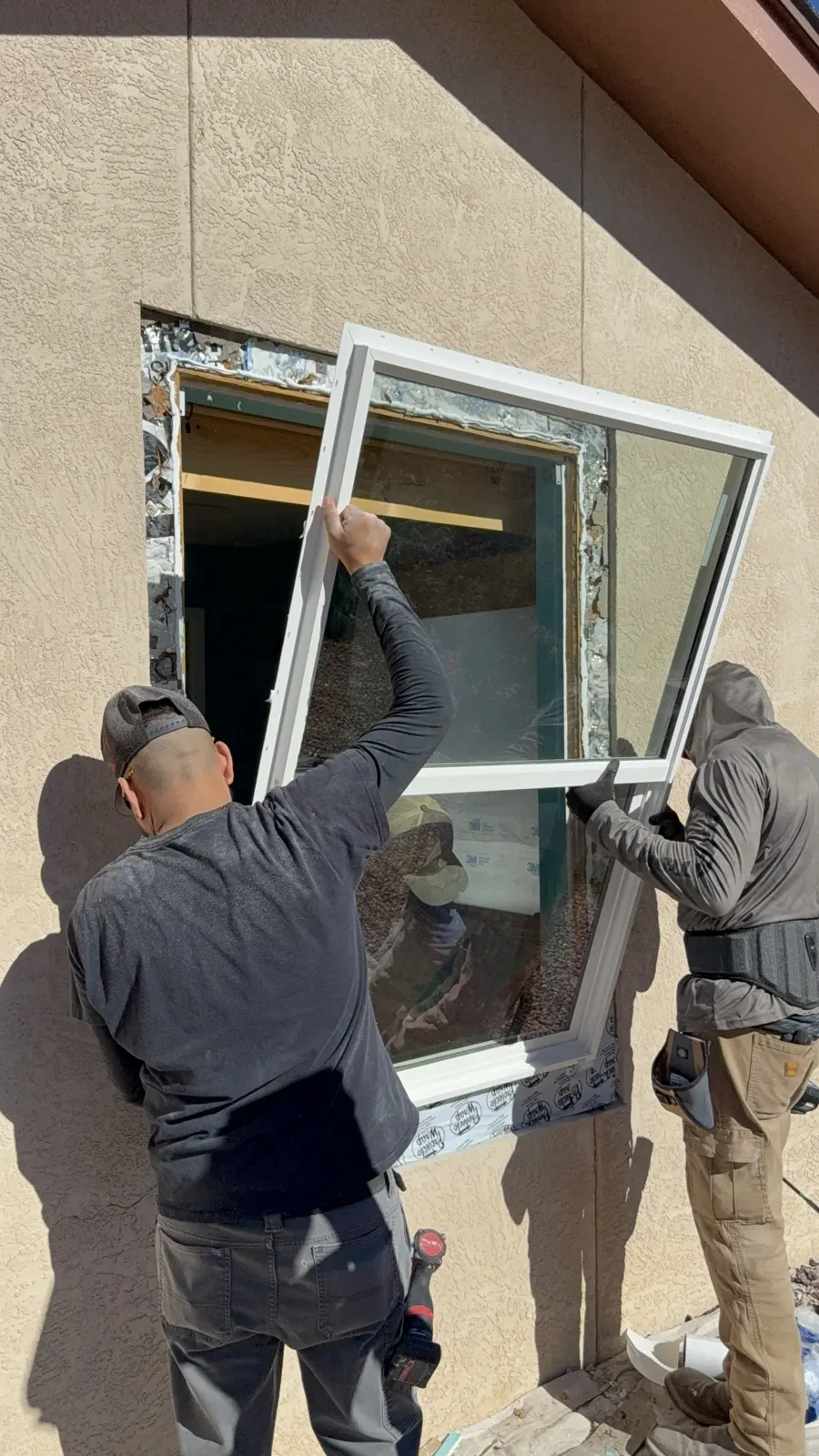
Full-frame replacement takes everything out down to the rough opening. On a stucco home that means cutting a band of stucco around the window, pulling the old nail-fin frame, inspecting the framing, rebuilding the waterproofing with flashing tape and a sloped sill, setting a new nail-fin window, and then building the stucco back up in layers. It takes longer and costs more, and it's the right call when there's rot, a history of leaks, a frame that's out of square, or a homeowner who wants the most glass the wall can hold.
On a typical Santa Fe home we often recommend a mix. The protected north and east windows with sound frames get retrofits. The west-facing kitchen window that's leaked into the sill for years gets the full treatment. Your quote shows which method we picked for each opening and why.
| Retrofit / insert | Full-frame with stucco cut-out | |
|---|---|---|
| Old frame | Stays, covered or trimmed | Removed to the framing |
| Stucco work | None | Cut, patched in layers, color-matched |
| Glass area | Slightly smaller | Same or larger |
| Chance to fix hidden water damage | Limited | Full |
| Time per opening | Shorter | Longer, plus stucco cure time |
| Relative cost | Lower | Higher |
Real Winwood installs
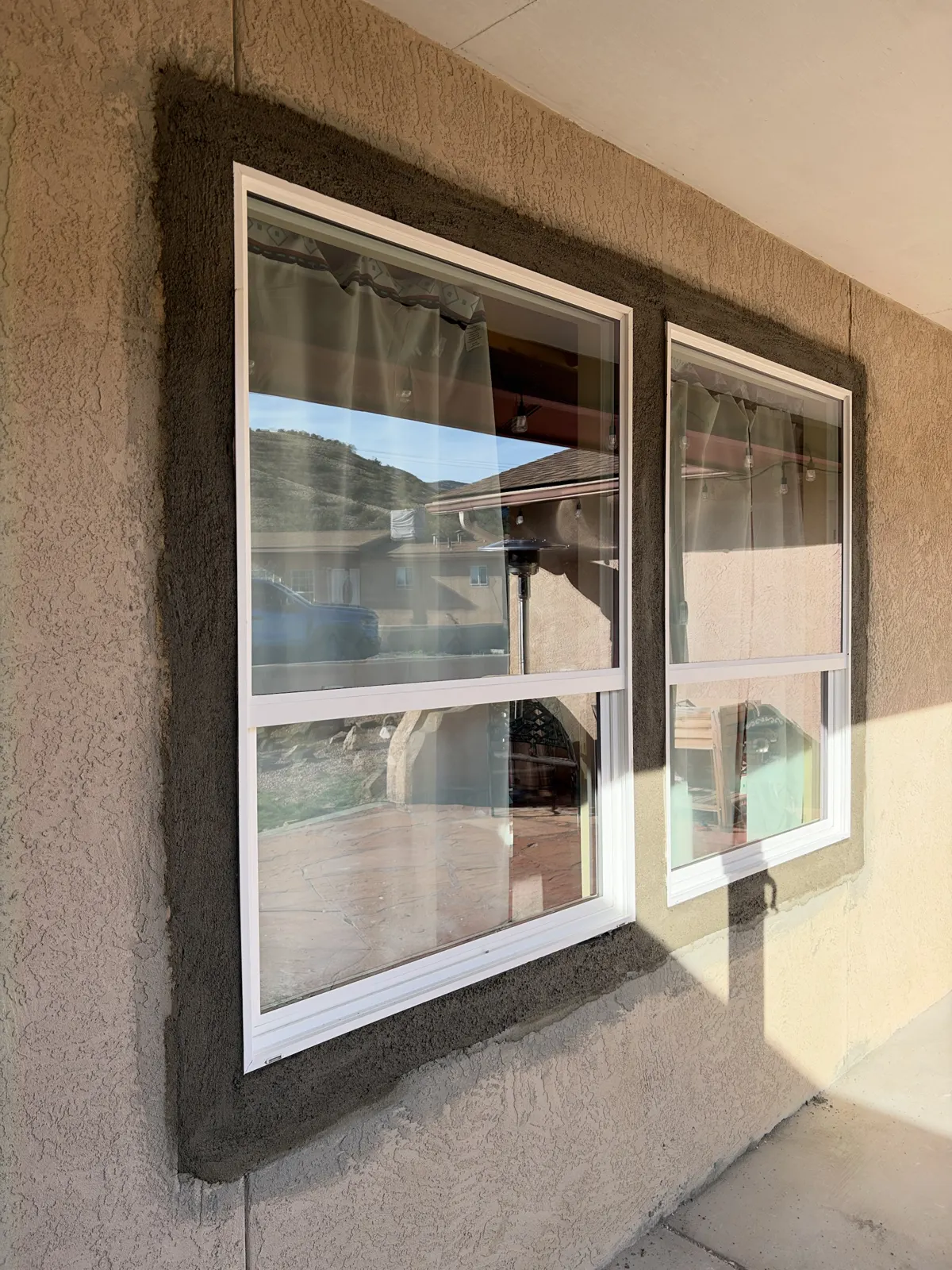
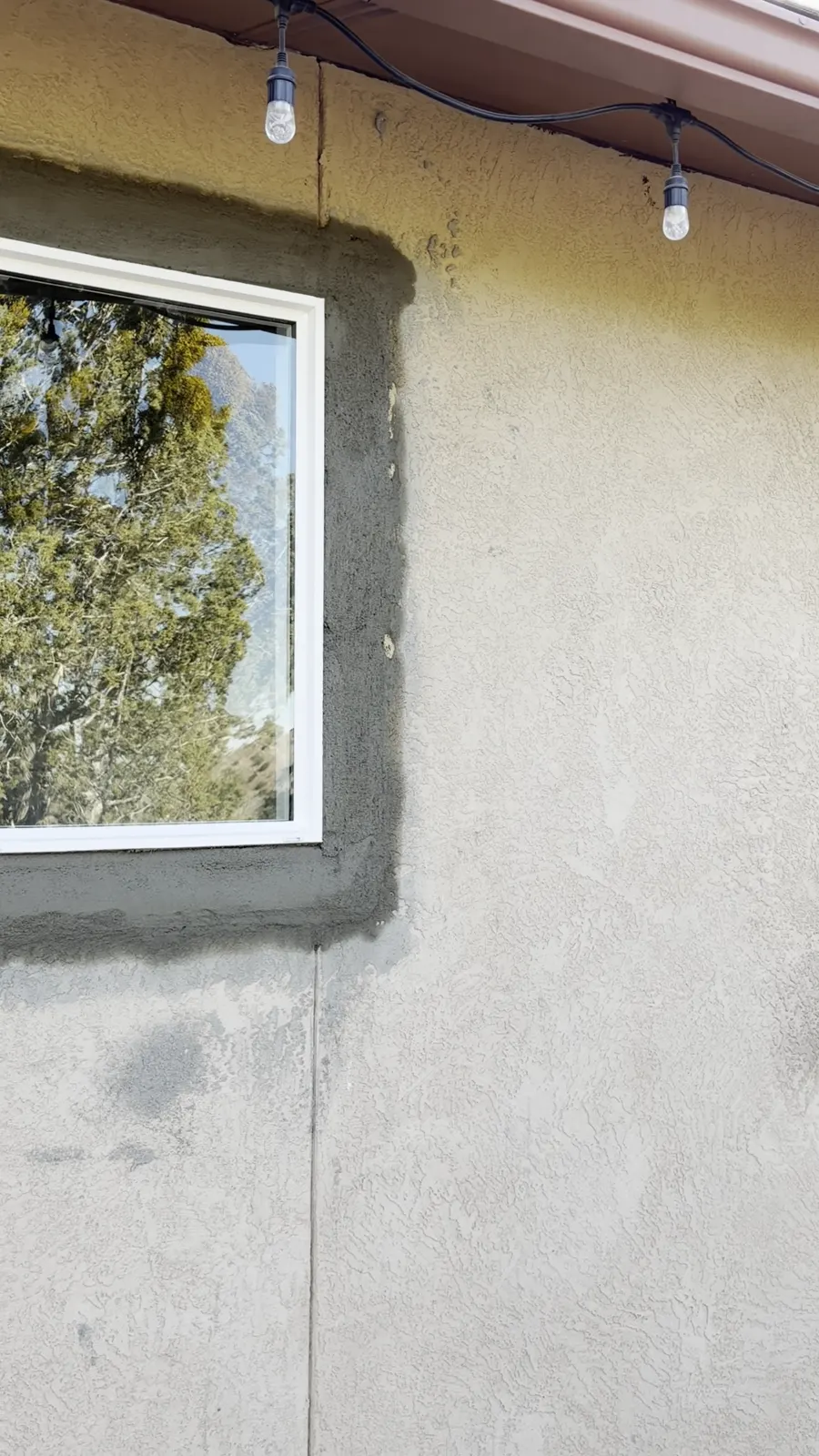
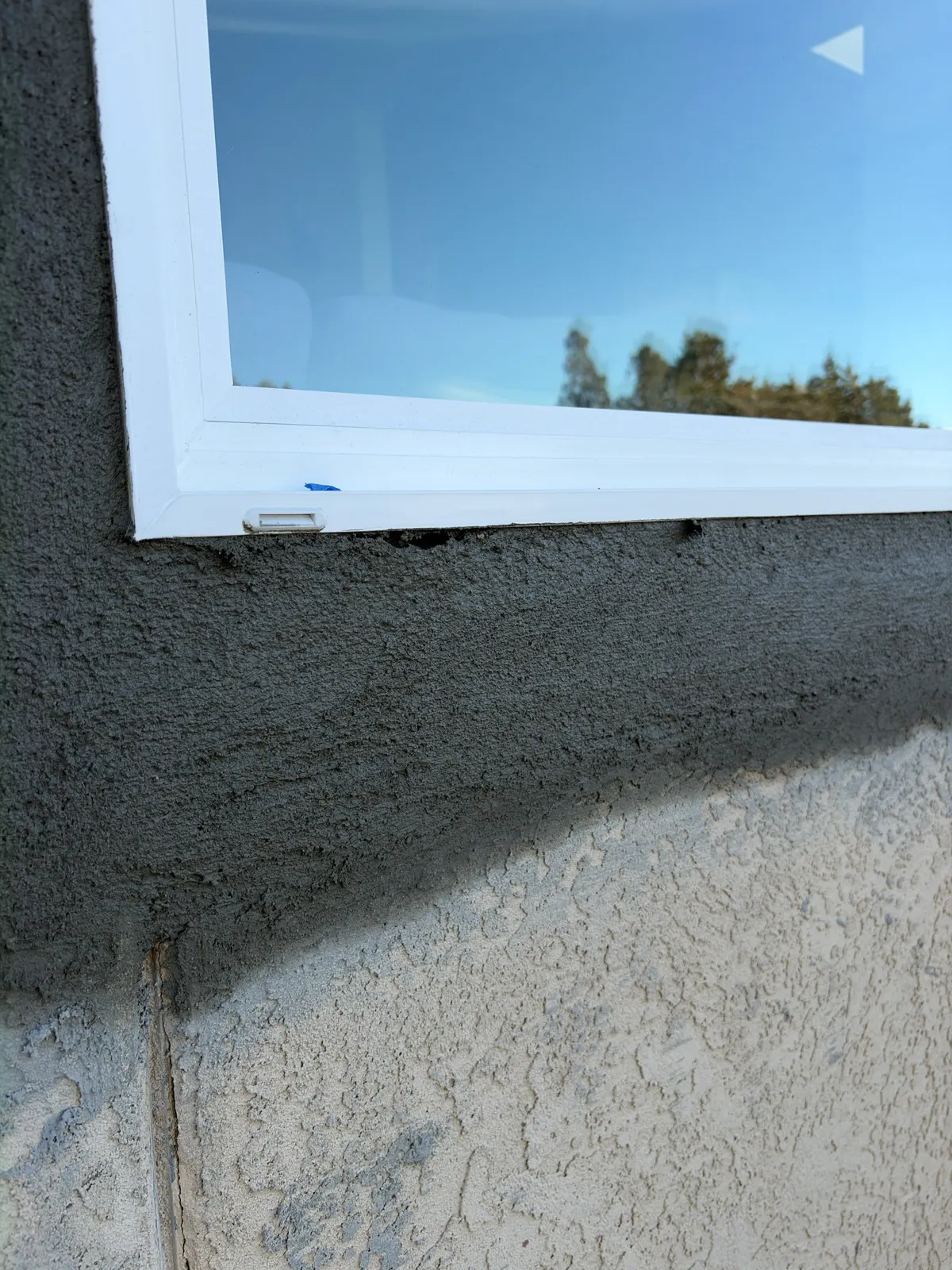
These are our own crews' photos and video stills, not stock images. You'll see the dark gray patches around each window. That is the stucco base coat after a full-frame cut-out, photographed before the finish coat went on. It's the honest middle of the job, and the reason a properly flashed window stays dry.
Choosing a frame for Santa Fe's sun and cold
There's no single best frame. There's a best frame for your budget, your house's style and the wall it sits in. Here's how we usually talk it through at the kitchen table.
Vinyl
Vinyl gives you the most window for the money. A well-made vinyl window with welded corners, a multi-chamber frame and a good glass package will out-insulate the aluminum windows most Santa Fe homes were built with. We lean toward white, almond, tan and other light exteriors, which shrug off the UV. When someone wants bronze or black, we talk about whether vinyl is the right material at all.
Fiberglass
Fiberglass expands and contracts at nearly the same rate as glass, so the seals aren't fighting the frame every time the temperature swings 40 degrees between dawn and mid-afternoon. It takes dark factory paint well, it's strong enough for large picture windows, and the frames can be slimmer, so you get more glass and more view. It costs more than vinyl and less than most clad wood.
Wood-clad
For Territorial, Pueblo Revival and historic homes, the inside of the window often matters as much as the outside. Wood-clad windows give you real pine or fir inside, which can be stained to match your doors, cabinets and trim, with an aluminum or composite skin outside that doesn't need painting every few summers. They're also the easiest way to get true or simulated divided lites that look right on an old facade.
Aluminum
Many of the windows we take out are original aluminum sliders: single-pane or early dual-pane, cold to the touch in January and hot in July. Modern thermally broken aluminum exists, but for most homes here vinyl or fiberglass does the same job better for the money. We only bring aluminum up for specific modern designs.
Historic districts and design review
Santa Fe protects a lot of its housing stock. If your home is in one of the city's historic districts (the Downtown and Eastside area, Don Gaspar, Westside-Guadalupe, Transition, or Historic Review), exterior changes including windows can require approval through the city's Historic Preservation Division, and some go before the Historic Districts Review Board. What gets approved depends on the building's status, whether the window is visible from the street, and how closely the new unit matches the old one in size, divisions, material and the depth it sits in the wall.
We don't pretend to be the city. What we do is build the quote so it's ready for that review: exact sizes, lite patterns, profile drawings from the manufacturer, exterior finish, and how the window will sit relative to the wall surface. We'll tell you when we think an opening is likely to need review, and we schedule the order after you have approval in hand, not before.
Outside the city's districts, many subdivisions such as Las Campanas and Rancho Viejo have their own architectural committees with color and style rules. Same approach: specs first, approval second, order third.
Glass that works with the sun, not against it
Santa Fe gets a lot of clear-sky days, and the light is strong. That's an asset in winter, when sun through south-facing glass is free heat, and a nuisance on west walls in June. Good glass selection lets you keep the first and cut the second.
- Low-E coatings are microscopically thin metal layers on the glass. Some let more of the sun's heat through (good for passive-solar south windows); others block more of it (good for west and east glass). We don't put the same coating on every side of the house unless it makes sense.
- Argon or krypton gas between the panes slows heat loss compared with air. Argon is standard on most quality units.
- Warm-edge spacers keep the edge of the glass warmer on cold mornings, which cuts down on condensation at the bottom of the pane.
- Triple pane is worth discussing on north walls, in Los Alamos, or anywhere comfort near the glass matters most. It's heavier and costs more, so we look at it opening by opening.
For a heating-dominated place like Santa Fe, the ENERGY STAR "Northern" zone criteria are the right benchmark. That's a low U-factor, roughly 0.22 or lower on the label. We show you the NFRC sticker numbers for what we quote so you can compare apples to apples.
Doors that close the gap
A worn patio slider can leak more air than every window in the room put together. The rollers flatten, the track wears, the weatherstrip compresses, and wind finds the gap. A replacement door with a fresh track, multi-point locking and a proper sill pan underneath fixes all of that at once.
We install vinyl and fiberglass sliders, hinged French patio doors, and larger multi-panel units for homes that want the portal and the room to feel like one space. For the front of the house, we replace entry doors in fiberglass and steel, with or without sidelites and transoms, and we pay attention to the threshold. That's where snowmelt off a portal roof tends to find its way in.
What your quote will and won't include
We'd rather lose a job on price than win it on a vague quote. Every Winwood quote lists:
- Each opening by room, with its measured size and the size we're ordering.
- Window style (single-hung, slider, casement, awning, picture, specialty shape) and operation direction.
- Frame material, interior and exterior colors, and any grille or divided-lite pattern.
- The glass package: number of panes, Low-E type, gas fill, tempered or obscure glass where code or privacy needs it.
- Install method for that opening: retrofit, flush-fin retrofit, or full-frame with stucco cut-out.
- Exterior finish work: stucco patch with color coat, or trim and sealant only.
- Interior finish: re-using your trim, new trim, or drywall return repair.
- Haul-away of the old units.
It won't include surprise add-ons on install day. If we open a wall and find rot or termite damage in the framing, we stop, show you, and price the repair before we go further.
Where we work around Santa Fe
Our crews cover the city and the communities that depend on it. Each area has its own housing story, and we've written a page for each one.
Santa Fe
Eastside adobes to Southside tract homes.
Eldorado
Passive-solar homes and steady wind.
Las Campanas
Large custom glass under HOA review.
Rancho Viejo
Builder windows now reaching retirement.
Tesuque
Old walls, deep openings, tall trees.
La Cienega
Rural homes in dust and open wind.
Los Alamos & White Rock
Mid-century houses at real altitude.
Pojoaque
Valley homes along the 84/285 corridor.
Española
Warmer valley, older housing, honest budgets.
Signs it's time to replace, and signs it isn't
Not every drafty window needs replacing. Sometimes a sash needs new weatherstrip, a balance spring needs swapping, or a bead of exterior caulk has let go. If that's what we see, we'll say so.
Replacement makes sense when you see:
- Fog or film between panes that won't wipe off. The seal has failed and the glass unit is done.
- Frost or ice on the inside of the glass on cold mornings, which usually means single-pane or failed dual-pane glass.
- Sashes that won't stay up, won't lock, or have to be forced open.
- Water stains on the sill, the drywall below the window, or the stucco under the corners.
- Gray, checked, or soft wood on an exterior sash or sill.
- Aluminum frames so cold in winter that condensation drips onto the sill.
- A room that's always the coldest in the house, and the window is the common factor.
If you have only one or two of these, you may be able to phase the work: worst windows first, the rest next year. We quote it either way.
Brands we put in Santa Fe homes
We install several manufacturers' lines, which lets us match the window to the house instead of the other way around. Depending on the job, that includes Milgard, AMSCO, Andersen and Anlin products, among others. Each brand has strengths: one has a vinyl line that handles UV especially well, another has a fiberglass or clad-wood series that suits historic work, another ships custom sizes faster. We'll tell you why we're recommending a particular line for your house, and we're happy to quote an alternative if you've already got a brand in mind.
Brand names belong to their respective owners. Winwood is an independent installer and is not owned by or affiliated with any window manufacturer.
Care after install
New windows need very little. A few habits keep them working for decades:
- Vacuum sliding tracks a few times a year, more often in spring wind season. Dust is what wears rollers.
- Keep weep holes at the bottom of the exterior frame clear so water that gets into the track can drain out.
- Clean vinyl and fiberglass with mild soap and water. Skip abrasive pads and solvents.
- Look over the exterior sealant joint every couple of years. The sun here is hard on everything, and a small touch-up is easy.
- If a wood interior was left unfinished, seal or stain it soon after install, before the dry air starts working on it.
Questions after the job? Call the same number. It's still {PHONE}.
Santa Fe homeowners ask us
How long does a typical Santa Fe window replacement take?
Once the windows arrive, a retrofit crew can often finish a whole house of ten to fifteen openings in one to two days. Full-frame installs with stucco cut-outs take longer per opening, and the stucco patch needs cure time between coats before the color coat, so the exterior finish may run a few extra days. Ordering usually adds several weeks before install day because most windows are built to your sizes.
Do I need to be home during the installation?
We ask that someone be home at the start of the day to walk through the plan and at the end for the walk-through. In between, many homeowners work from another room or step out. We cover floors and furniture near each opening and keep the work area to one or two rooms at a time.
Can you match the stucco color after cutting around a window?
Yes. The patch is built back in layers and the final color coat is matched to your existing wall. Stucco that has weathered for years may read slightly different up close at first; matching the texture and color is part of the job, and we walk it with you when it's done.
Will new windows really lower my heating bill?
Replacing single-pane or early aluminum windows with modern Low-E, gas-filled units usually makes rooms noticeably more comfortable and cuts heat loss through the glass. How much your bill drops depends on the rest of the house: insulation, air sealing, the furnace and how you heat. We won't promise a specific percentage, but comfort near the glass improves right away.
Do you work inside Santa Fe's historic districts?
Yes. We prepare quotes with the size, divided-lite pattern, material and profile details that historic review typically asks for, and we hold the order until you have approval from the city. Whether approval is needed depends on your property, so it's worth checking with the Historic Preservation Division early.
How do I get a quote?
Call (505) 522-7707. We set a time to visit, measure every opening, talk through options, and leave you a written, itemized quote. The visit and the quote are free.
Let's measure your windows
One call sets up a free visit anywhere from Española to Eldorado.